Fatimah Ibrahim

Profile
Professor of Biomedical Engineering at Universiti Malaya, leading biosensor, microfluidics, and medical device innovation.
How did you get involved in engineering projects to address climate change? What were your background skills or experience?
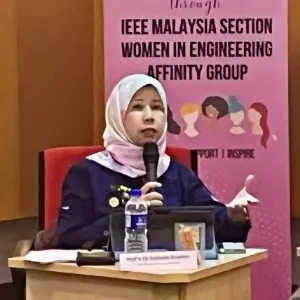
Prof. Fatimah applied her biomedical engineering expertise in biosensors, microfluidics, and IoT-based medical devices to develop low-cost, rapid diagnostics and sustainable health technologies. Her background in electrical and biomedical engineering enabled her to design innovative systems that improve healthcare accessibility while addressing global health and environmental challenges.
What projects were you invloved in and what did you do?
Centrifugal microfluidic platforms for rapid dengue detection. Carbon BioMEMS chips for foodborne pathogen detection. IoT-guided drones for medical delivery. Global Microbiome Conservancy with MIT, preserving microbial heritage. EU Horizon 2020 SALSET Project, saliva-based biosensors for disease detection.
What did you achieve?
Her innovations increased sensitivity of dengue diagnostics up to 15×, produced patented pathogen detection devices, and led to commercialization of wearable and diagnostic technologies. The microbiome research preserved microbial diversity for future studies. Her projects improved healthcare delivery, reduced costs, and contributed to global efforts in combating infectious diseases.
What challenges did you face and how?
Translating lab prototypes to cost-effective products. Meeting regulatory approval for medical devices. Ensuring community acceptance and practical usability. She overcame these through industry partnerships, technology transfer programs (UM Deep Tech), patent filings, and clinical validation studies.